
Ancient ruins, rugged landscapes and a coastline that draws in Hollywood’s elite, Sardinia delivers adventure and glamour in equal measure. Invaders and settlers have come here for centuries, and today’s island has lost none of its magnetic attraction having won the second spot in Condé Nast Traveler’s 2024 Readers’ Choice Awards for ‘the best islands in Europe.’ Travel through this Mediterranean isle to experience a blend of fascinating history, sunny shores and Italian heritage.

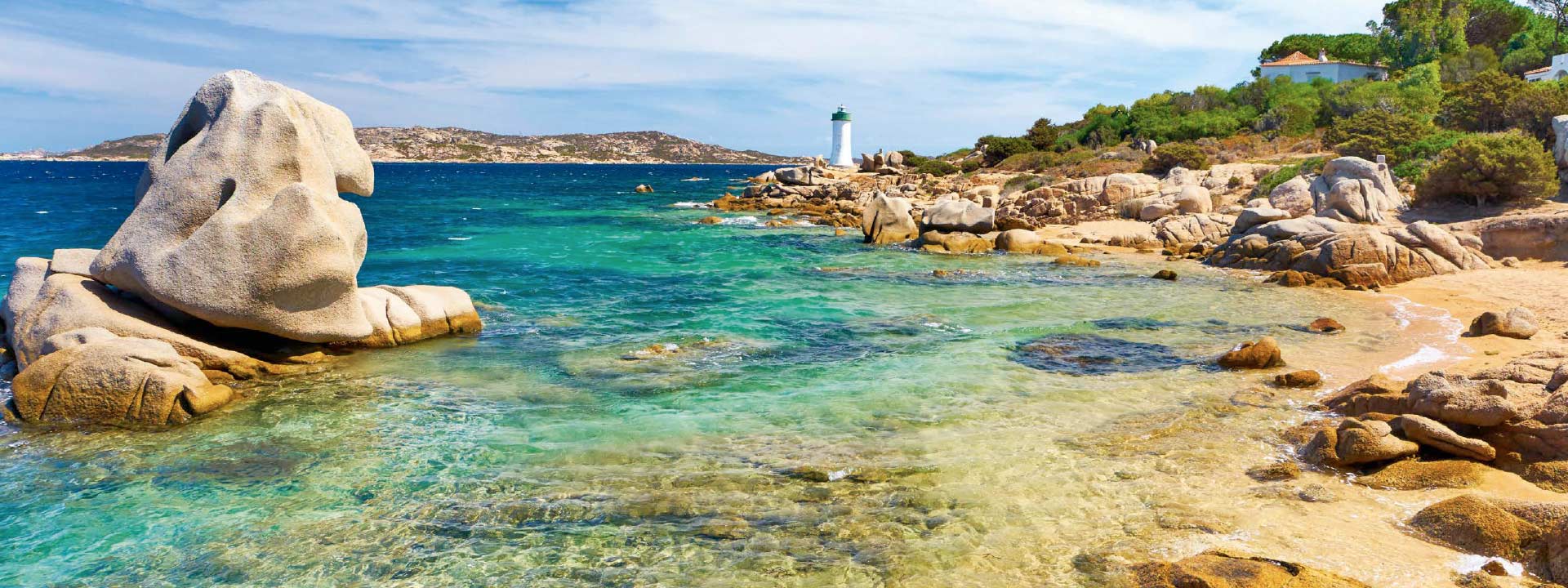
Cala Domestica beach on the Costa Verde
NURAGIC ERA ARTIFACTS
I’m startled to see a small-scale sphinx in an Italian museum, but maybe I shouldn’t be. After all, the island of Sardinia is one of the oldest inhabited lands in Europe, with permanent settlements that date back to around 6000 B.C.E. This relic, excavated in Bastione di Santa Caterina, is now part of a collection resulting from a 30-year archaeological dig. It’s not even the most dramatic exhibit at the National Archaeological Museum of Cagliari — that honor is reserved for the stone warriors found at Mont’e Prama.
Created in the Nuragic era, the 28 stone figures are in varying degrees of completeness and fall into three core categories: warrior, archer and boxer. The warriors carry a sword and shield and wear horned helmets and short tunics. Archers, who also wear horned helmets, hold bows with their forearms protected by gauntlets. Finally, the boxers are stouter and much larger than the others. Each is bare-chested, with its left arm raised and bent over the head to form a curved shield.
I’m entranced by the wealth of artifacts in this compact gallery. Historically, traders crossing the Mediterranean would make a stop in Sardinia and leave behind a remnant of their culture and identity. Archaeologists speculate that the first settlers arrived from all directions: southbound groups from the Italian peninsula, eastbound factions from current-day Spain and northbound travelers from North Africa and Greece. Throughout the Iron Age, organized communities became widespread on Sardinia and craftsmen had the time and resources to depict their art and ethnicity in stone, pottery and bronze. The island was colonized by the Roman Empire in 238 B.C.E., and their dominion over Sardinia lasted nearly 700 years. Evidence of their civilization — gold coins, stone carvings and illustrative mosaics — is still being uncovered today

Archaeological Museum of Cagliari
INTO THE BLUE ZONE
Dan Buettner, an explorer and National Geographic Fellow, coined the term ‘Blue Zones’ (areas where people live exceptionally long and healthy lives) during a 2004 expedition. His team of scientists traveled the globe in search of communities with extraordinary longevity and mapped their findings using concentric circles darkened with blue ink, hence the term. Sardinia is one of only five Blue Zones around the world, the others being Okinawa in Japan, Nicoya in Costa Rica, Ikaria in Greece and Loma Linda in California.
The island’s geography, customs and environment have all contributed to the prolonged existence of its people. D.H. Lawrence’s 1921 book Sea and Sardinia describes the citizenry’s resilience perfectly: ‘They say neither Romans nor Phoenicians, Greeks nor Arabs ever subdued Sardinia.’


Seaside lunch at Tirso Beach Club
The Phoenicians, who arrived around 1000 B.C.E., challenged the Sardinians for territory and drove residents inland. With every fresh wave of invaders, natives kept moving upward into the mountains to seek safety.
Today, these high-altitude areas, particularly Villagrande Strisaili, are recognized as having the world’s highest concentration of male centenarians, thanks, in part, to the shepherding way of life. Sheep farming, it turns out, is very beneficial to one’s health; walking miles every day and carrying heavy vessels of milk ensures ample exercise and muscle building. The people here, including the oldest residents, incorporate exercise into their daily routine, whether it’s walking steep roads or climbing flights of stairs.
When it comes to diet and cooking methods, not much has changed in these hilly parts of the island in the past 100 years. For example, minestrone soup, typically made with local vegetables, beans, olive oil and pasta, has been a mealtime favorite for generations. That dietary mainstay paired with homemade sourdough, kneaded by hand and baked in wood-burning ovens, has been proven to keep inflammation in check and immune systems strong. And to wash it all down? Cannonau, a red wine of high polyphenol content that’s been linked to heart health.

Porto Giunco beach, near Capo Carbonara and Villasimiius
VOLCANIC VINICULTURE
I head inland to Serdiana, a town laced with vineyards, to visit family-owned Audarya Winery. The area is arid and dotted with palm trees and stands of cactuses. Third-generation vintners Salvatore and Nicoletta Pala have built on their father Enrico’s winemaking experience to produce wines using native grape varieties, thus making maximum use of the terroir. They include cannonau, bovale and vermentino. Mineral-rich volcanic soil and fresh sea air serve as the perfect incubator for these vines, planted by Enrico and his father in the 1940s.
I sit down and prepare to taste eight different wines produced here. Floor-to-ceiling windows in the modern tasting room reveal orderly rows of grapevines stretching as far as the eye can see. The inviting spread of olives, Pecorino cheese, charcuterie and hand-made crackers is accompanied by crisp whites and full-bodied reds that have been matured in oak barrels. I sip a light, bright Vermentino di Sardegna, followed by an aromatic Cannonau di Sardegna, and finally, the winery’s flagship wine, a Nuracada — named after the medieval village that once stood on this parcel of land.

Port of Alghero
COASTAL BEAUTY
I knew about Costa Smeralda’s spectacular blue waters and untouched white-sand beaches thanks to Instagram, with big names like Anne Hathaway, Beyoncé and Heidi Klum having posted about their travels there. Home to posh resorts and villas, the area attracts high-end visitors who laze on its beaches and wade in its chilly, clear waters. The Poetto coast, near Cagliari, is a stretch of beach that extends for five miles. On my drive to lunch, I spy the famous pink flamingos along the roadside. They’re standing on reedy legs and gorging themselves on the local bounty of shellfish in shallow ponds and salt marshes. In the afternoon, I board a catamaran for a sailing tour of Devil’s Saddle, a promontory in the Bay of Calamosca. As we bob along, the captain points out sites where ancestral water worshippers built stone cisterns to collect that life-giving gift of the gods. Playful dolphins jump and splash as they follow our path. I pluck up the courage to jump into the freezing cold waters — I can’t resist the opportunity to float in the salty blue Med for a few blissful minutes.
Later that day, at five-star Hotel Palazzo Tirso Cagliari, I walk into Cielo’s glass walled elevator and head up to the rooftop restaurant, admiring the 360-degree view of the Gulf of Angels and the medieval downtown district before sitting down to a plate of pasta. Malloreddus alla Campidanese is homemade gnocchi, cooked duro — slightly firmer than al dente — then mixed with a sausage-based red sauce and topped with a generous sprinkling of grated Pecorino. I’m told the sauce gets its unique flavor and blood-orange hue from the pinch of saffron in the recipe.

Travel Leaders Image
CITY WALK
The next morning, I’m joined by guide Silvia Bondanini of Sardinia Magic Experience for a tour of Cagliari, Sardinia’s main city. “A walk through Cagliari is the perfect way to explore it. The city was founded in the sixth century B.C.E. and has seen many populations who left their imprint,” she tells me, her almond-shaped eyes widening every time she speaks.
Our steep walk through the narrow streets of the Castello district takes us past churches, open-air restaurants and artists’ studios. A tray of traditional Sardinian cookies displayed at a timeworn storefront lures me into the dimly lit bakery, Durke Maurizia Pala. Today’s offering is lemon ricotta cookies, and I can’t resist a bite before we continue our journey onward and upward toward the fortress.
The citadel sits high on top of a hill at the heart of Cagliari, with one side reinforced by gargantuan limestone walls. Positioning myself in the slim shade of a palm tree, I appreciate the sea view and catch my breath.

Cielo rooftop restaurant at Hotel Palazzo Tirso
“Cagliari is alive with activities and so many layers to explore,” Silvia tells me. “I’m often guiding visitors through the streets, telling our legends and local stories while taking in the panoramic views.”
We march on and reach the medieval Tower of the Elephant, so called because of the ancient name for Via Stretta, Ruga Leofantis. It reveals a spiked gate once used to lock in residents and repel invaders. It’s soon time to make our way to the City Hall and 13th-century Romanesque Cagliari Cathedral. Downstairs, in its baroque crypt, I’m fascinated by the 192 niches that contain relics of the island’s ancestral martyrs.
“The old town is the most fascinating area,” Silvia explains. “There’s a mix of old, modern and impressive sights that very often spark the desire to see and experience more of it.”
At the end of the tour, Silvia and I part ways at the ancient Roman Amphitheater of Cagliari,
built in the second century C.E. It’s no stretch to imagine a full audience attending a theatrical production here, with the beautiful Mediterranean Sea as a majestic backdrop. With so much history and beauty concentrated on one island, I understand why generations of people have been drawn to Sardinia.