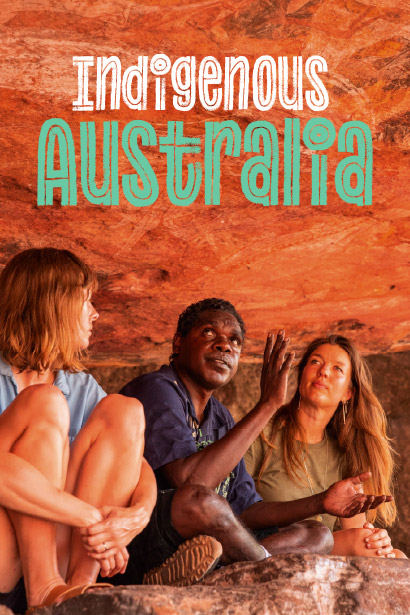
From foraging for native ingredients on a guided walk to shopping for souvenirs made by Aboriginal craftspeople, this is how best to explore Australia’s Indigenous culture — a rich mosaic of sacred communities, languages and traditions.
Australia’s Aboriginal and Torres Strait Islanders proudly hold the title of the world’s oldest continuous living culture. Archaeological evidence shows they’ve lived across the continent for at least 65,000 years, passing down their beliefs, knowledge and stories for countless generations.
Museums dedicated to Aboriginal culture and history are found in every Australian city but, as an oral storytelling culture, the best way to experience it is first-hand with an Aboriginal guide. Scouting the shaded creeks of Queensland’s Daintree Rainforest in search of crabs, spear in hand. Sitting down around the campfire as a hushed sunset settles over Uluru. Bathing in cleansing smoke as part of a welcoming ceremony beneath Sydney Harbour Bridge.
And while most modern-day tourism involves rushing from checkbox to checkbox, an encounter with a truly unique culture is an invitation to slow down. Allow extra days to explore and secrets will unfurl — dingo tracks that previously went unnoticed, hidden stories etched into paintings at a community art gallery and the time-honored knowledge carried in constellations glittering across the night sky.
Ultimately, Aboriginal culture is about connection — between each other and with the environment — making every experience deeply personal and unique. Ask questions, listen and walk away with an entirely different perspective of this ancient and storied land.

Uluru-Kata Tjuta National Park
THE NORTHERN TERRITORY
Around the same size as France, Spain and Italy combined, the 520,000-square-mile Northern Territory stretches from Australia’s dusty red interior to the Timor Sea. The region is home to over 100 Aboriginal language groups, spoken by clans who each have their own distinct cultural practices and kinship systems.
Like elsewhere in Australia, British settlement from the 1820s brought painful changes to the territory, including displacement and violence as colonists sought to transform the vast interior into pastoral land. Many Aboriginal people became the backbone of this emerging industry, often working under harsh conditions. Out of the crucible of colonization emerged a proud land-rights movement which, after years of protest and litigation, culminated in ancestral lands being returned to Aboriginal ownership in 1975. That movement has continued apace, with parcels of land across the territory continuing to be returned to Traditional Owners, most recently in 2024 and 2025.
The Northern Territory can be split into two sections — the Red Centre and Top End — with each offering contrasting perspectives for travelers. In the Red Centre, the sacred sandstone monolith Uluru is a major drawcard, but the region is also emerging as a premier light art destination. Created by acclaimed British artist Bruce Munro, Field of Light brings the desert to life with thousands of color-changing lights, while Wintjiri Wiru sees over 1,000 drones take to the skies for a modern retelling of an ancient Anangu story. For a different perspective, walk in the footsteps of Anangu people on the new five-day Uluru-Kata Tjuta Signature Walk, which launched in April 2026.
In the Top End, travelers can sample native foods like nutty wattleseed, desert lime and tart Kakadu plums at restaurants and market stalls in Darwin. For an immersive experience, catch the ferry to the Tiwi Islands to share billy tea and damper (a type of bread) with the Tiwi ladies and forage for bush ingredients. Alternatively, set off on a day trip to Kakadu National Park, where rock art estimated to be up to 20,000 years old can be found among sandstone escarpments. Keep an eye out for crocodiles during a cruise down the park’s Yellow Water Billabong, too.

Ord River, Kununurra
ARNHEM LAND
This rugged and remote enclave in the far north-east of the Northern Territory is home to bountiful savanna woodlands and floodplains. Archaeological sites like Madjedbebe, a sandstone shelter where scientists have unearthed axes and grindstones, suggest the Mirrar people have lived here for at least 65,000 years, making it one of the earliest known sites of human occupation in Australia. Historical records show the Yolngu people also traded for centuries with their close neighbors, the Macassan fishermen of Indonesia.
The Yolngu are north-east Arnhem Land’s traditional owners, and their deep spiritual and ancestral connections to the land and waters of Northern Australia continue to this day. For generations, Yolngu communities have sustainably managed the area, maintaining rich cultural practices that remain an integral part of their stewardship.
The journey to reach Arnhem Land, typically by 90-minute flight or two-day drive from Darwin, means it’s worth taking it slow and setting aside a few days to immerse yourself in the region. Set off on a guided hike along the coast retracing Yolngu songlines or take a seat on the wide sandy beaches to learn how to craft a spear using traditional methods. Visit the new community-owned Gapuwiyak Culture and Arts on the shores of placid Lake Evella. The center supports over 100 local artists practicing carving, weaving, painting and more. Visit in August for Garma Festival, a celebration of Yolngu culture with an evolving program bursting with dance performances, music, movies and poetry.

Elephant Rock, The Kimberley
THE KIMBERLEY
Across the Northern Territory’s western border lies the Kimberley, a wild swath of sparsely settled land best known for its red gorges, isolated coastline and the challenging Gibb River Road, an unsealed 410-mile driving route through the region’s savanna heartland. Aboriginal people have occupied the Kimberley for an estimated 40,000-50,000 years, and the region holds one of the greatest concentrations of preserved Indigenous rock art in the world, at places including Bandilngan (Windjana Gorge) National Park, Munurru and Raft Point.
Historical records also show Aboriginal people collected the coastline’s lustrous pearls and traded them across Australia to be used in rituals and ceremonies. The pearling industry continues today, with major pearl houses establishing their base in the regional capital, Broome. Here, learn how the coastline has nourished generations of Aboriginal people during a hands-on tour exploring the town’s expansive mangroves. Alternatively, hop into a 4WD to explore the northern beaches and cook a meal using a traditional oven buried in the ground.
Further inland, join Aboriginal guides for an overnight safari deep into Purnululu National Park, which is best known for the tiger-striped domes of the Bungle Bungles, the majestic Cathedral Gorge and Picaninny Creek. For a less dusty experience, climb aboard an Aboriginal-led cruise to Sunday Island and explore Kimberley Marine Park, a 28,700-square-mile reserve home to dugongs, manta rays and sea turtles. Along the way, travelers will learn about the region’s pearling history and visit sacred cultural sites.

Orpheus Island, Great Barrier Reef
NORTH QUEENSLAND
The Aboriginal people in and surrounding Cairns fished and foraged from the creeks of the leafy Daintree Rainforest to the waters of the Great Barrier Reef for tens of thousands of years. They enjoyed a varied diet that included eels, turtles, wallabies and cassowaries.
Today, the Yirrganydji people continue to be proud custodians of northern Queensland’s coastal region between Cairns and Port Douglas. They share their in-depth knowledge of the rainforest and reef to help scientists and conservationists preserve and care for their country.
There are many ways to experience this enduring connection, and it’s best done through the eyes of Aboriginal guides. For a unique day out from Cairns and to see the Great Barrier Reef, join a cruise that includes snorkeling on the reef and retellings of creationist cultural stories. Back on terra firma, learn to throw a spear and forage for mud crabs in the shallows of Mossman Gorge on a guided tour.
To slow down and fully immerse yourself in Aboriginal culture, join an overnight camping trip from Cairns with Indigenous guides. Campers are welcomed onto traditional lands with a smoke ceremony before learning about native bush foods and medicines, then settling in for a night of storytelling around the campfire beneath a blanket of stars.
While Cairns is a popular destination for travelers, the rugged Old Telegraph Track from Cairns to Cape York is a true 4WD adventure complete with river crossings, swimming pit stops beneath raging waterfalls and stays at working cattle stations. The reward is remote Cape York, the northernmost point of the Australian mainland, where visitors can learn about the region’s Aboriginal and pearling history during visits to surrounding Thursday and Friday islands.

The iconic Sydney Opera House
SYDNEY
Modern-day Sydney sits on the ancestral lands of the Eora Nation, which comprises around 29 clan groups stretching from Balmain to Manly. Archaeological evidence, such as engravings and rock art, reveal these communities relied on canoes made from bark to fish, to gather and navigate Sydney Harbour’s intricate coastline of coves and inlets. The abundant seafood and diversity of plants that allowed Sydney’s first inhabitants to flourish were also what attracted the British to establish their first colony at Port Jackson in 1788. Some Aboriginal leaders, such as Pemulwuy, led fierce resistance against colonial occupation, and their stories can be found in the Museum of Sydney’s extensive Aboriginal history exhibits.
But Sydney’s Aboriginal culture isn’t confined to museum displays and history books. Travelers can learn about and taste Indigenous bush foods on a one-hour guided walk through the Botanic Gardens of Sydney. And at The Rocks, visitors can take a historical walking tour that begins with a traditional welcome onto Eora country, including a touch of ceremonial ochre paint on their hands or face. After being welcomed, travelers embark on a leisurely walk to learn about the coast’s historical and continuing significance to Aboriginal people.
To fully appreciate the harbor’s complex landscape and ecosystem, strap into a harness for the Burrawa Aboriginal Climb, which involves walking to the summit of Sydney Harbour Bridge and hearing Aboriginal storytellers share their unique perspective of the city.
The rugged Blue Mountains, named for the haze of eucalyptus oil that bathes them in their signature shade, are a worthy day trip from Sydney. Here, visitors can learn about traditional lore from an Aboriginal custodian.
Writer: Justin Meneguzzi