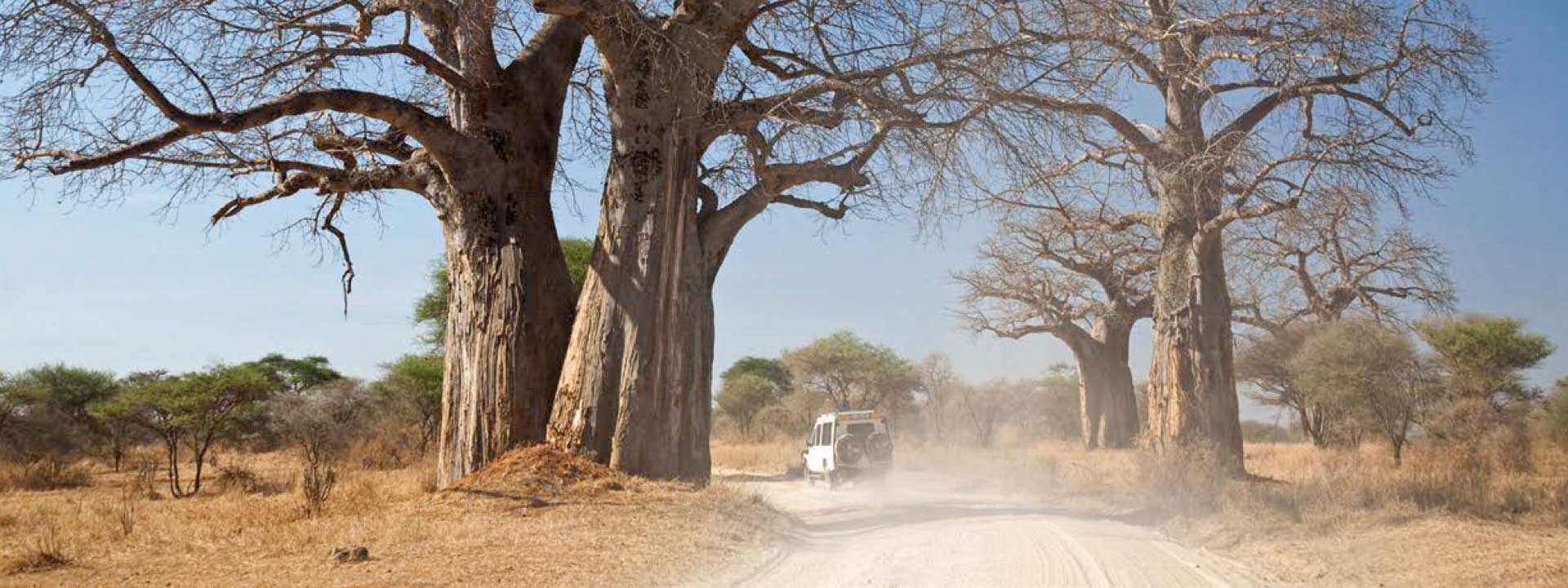
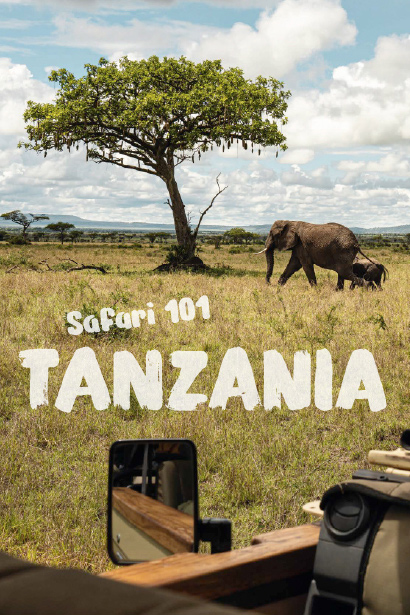
From Africa’s tallest peak and baobab-laden wilderness to a tropical Indian Ocean coastline spilling onto pristine archipelagos, Tanzania has long drawn intrepid travelers. Many staked a claim, but the declaration of independence in 1961 marked a turning point not only for its citizens — but its wildlife, as well. Today, over 40% of Tanzania’s land is protected and acts as the stage to some of Africa’s most extraordinary safari experiences where The Big Five (elephant, lion, leopard, buffalo and rhinoceros) all put on a show. This first-timer’s guide breaks down where to go, what to expect and how to plan a trip that makes the most of the country’s celebrated landscapes.
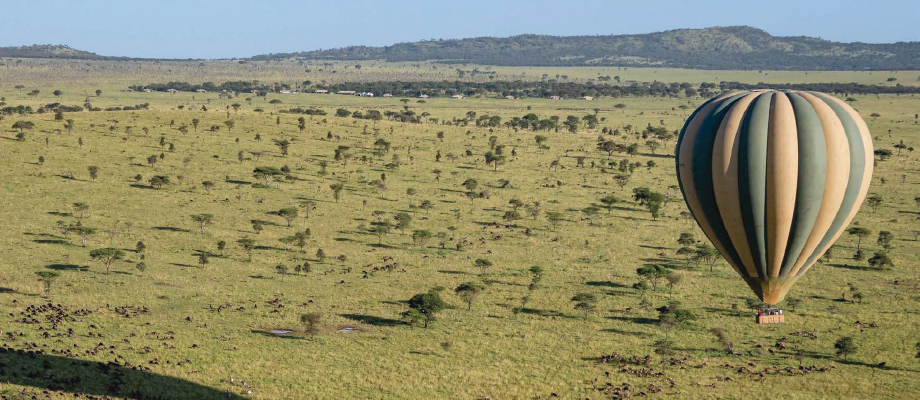
The Great Migration
WHERE SHOULD YOU GO FOR AN UNFORGETTABLE SAFARI?
As East Africa’s largest country, Tanzania’s topography and its wildlife can vary greatly. However, planning a trip needn’t be daunting, with land safaris generally divided into two main circuits: northern and southern.
The north loop across the Serengeti is by far the most popular. Mobile camps are set up along the Great Migration route to give visitors a front-row seat as the hooves of around 1.8 million wildebeest, zebra and gazelle kick up dust, charging northward in search of fresh pastures. With the national park home to one of Africa’s highest densities of apex predators, lions, cheetahs and leopards lie in wait for the mass arrival. Expect plenty of heart-in-mouth moments — particularly during peak wildebeest calving season in February and March, when as many as 500,000 mothers give birth on the move.
June brings the howls and hoots of rutting season, along with the first river crossings, as the beasts face off with Nile crocodiles patrolling the Grumeti River. Smaller in scale, the Grumeti crossing is less known than the famously deadly Mara River crossing further north. By August, desperate, densely packed herds are prepared to risk everything to cross its deep, fast-flowing currents. With the Mara’s ferocious crocodiles poised in the water and predators awaiting on either bank, it’s a sight both spectacular and gruesome in equal parts.
A trip to the Serengeti is often combined with the adjoining Ngorongoro Conservation Area. Here, lodges perch around the rim of the world’s largest intact caldera, 2,000 feet above the swamps, springs, forests and plains that sustain the highest concentration of mammals in Africa. The surrounding highlands are also a popular base, providing plenty of opportunity for meaningful cultural experiences hosted by the local Maasai community, who have farmed the area for centuries.
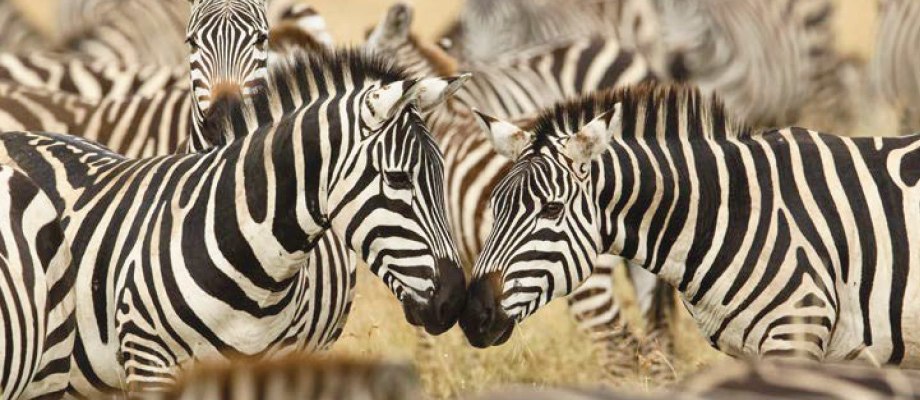
Burchell’s Zebra, Serengeti National Park
Tarangire National Park — the Northern Circuit’s other draw card — is sometimes overlooked by its limelight-stealing neighbors, but makes an equally deserving addition to any itinerary. Lower visitor numbers, particularly to the park’s south, mean half-day game drives through regions with an array of birdlife and otherworldly baobab trees can often happen without seeing another vehicle. Rhinos are the only ‘Big Five’ species that don’t reside here; however, most visitors come for the park’s 2,500-strong African elephant population — the highest concentration in the country. July to November heralds the dry season, with herds congregating at the central Tarangire River, alongside pods of ornery — and fiercely territorial — hippos.
The national parks of Ruaha and Nyerere are the southern circuit’s stars and have all the makings of a truly remote adventure. Vast Ruaha weaves together approximately 8,000 square miles of savanna with ancient baobab forests and sprawling wetlands. Off the beaten track, visitor numbers are a fraction of those seen in the north. Most of the park’s accommodation is concentrated around the central Great Ruaha and Mwagusi rivers — the stomping ground of a sizable big cat population. Game drives come as part of the territory, while walking safaris — accompanied by an experienced guide and trained armed guard — are becoming increasingly popular.
Of all Tanzania’s national parks, Ruaha is just second in size to 11,500-square-mile Nyerere (roughly the same size as Belgium). One of the country’s newest national parks, it was formally designated in 2019, carved out from the former Selous Game Reserve. The area’s southern reaches are given over to hunting concessions, but that’s not the only reason to stay in its northern climes. The Rufiji River’s meandering maze of channels flows here, drawing all walks of animal life, like the critically endangered black rhino.
Away from the northern and southern circuits, Tanzania’s western national parks take wilderness up a notch again, being reachable only by boat or light aircraft. Hemming the eastern white-sand shores of Lake Tanganyika, Gombe Stream National Park’s forests are where Dr. Jane Goodall arrived in 1960 to carry out her pioneering field research into chimpanzee behavior. Alongside Mahale Mountains National Park to the south, it’s one of the best places on the planet for chimpanzee trekking.
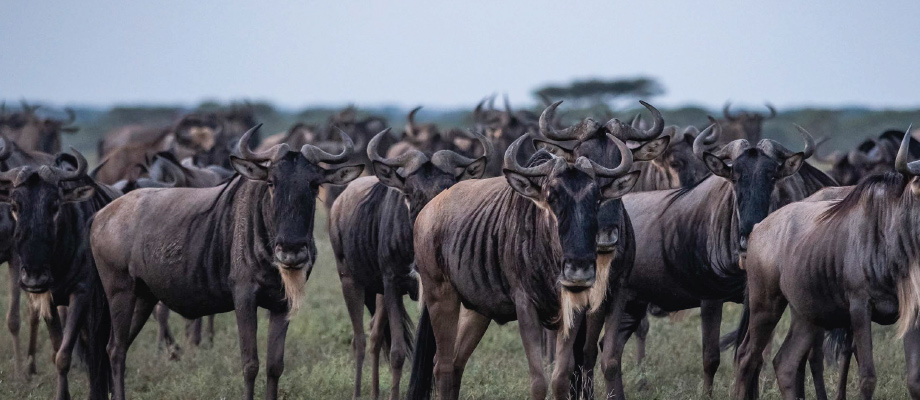
Blue Wildebeest, Ngorongoro Crater
WHAT ARE SOME OF THE MOST POPULAR SPECIES?
Tanzania is home to some of the largest numbers of big cats on the planet. More lions are thought to live here than in any other African nation, with scientists estimating the Ruaha landscape alone holds just under one-tenth of all the lions remaining in sub-Saharan Africa. Lion density is at its highest in the Serengeti due to the abundance of prey. This is particularly true on early morning drives, as the pride polishes off the night’s kill, or at golden hour, when temperatures drop and thirst lures mothers and their cubs to watering holes.
The nimble cheetah prefers to stalk its prey during the daylight hours. Lone females with little mouths to feed can be spotted lying in wait amid the Serengeti’s long grasses as the Great Migration approaches.
Solitary in nature, leopards are the most elusive of the big cats and can be particularly tricky to track. With a propensity for dense woodland, they spend much of their days snoozing on the upper branches of acacia and aptly named sausage trees (so called after their strikingly shaped fruit). The northwestern lakes of Nyerere boast some of the country’s largest numbers, as does the Serengeti, while Tarangire is also home to many of the animals.
Aside from big cats, it’s the giants of the animal kingdom that rank highly on most safari-goers’ lists. As little as 10 years ago, elephant numbers were under threat due to poaching and the illegal ivory trade. Today, the population is growing, thanks to efforts by international organizations like the World Wildlife Fund and local initiatives like Wild Survivors, which works with communities to foster human-elephant coexistence. As well as Tarangire, herds can be seen splashing around in the Rufiji River in Nyerere, while Ngorongoro Crater is known for its big tusker bulls and black rhino.
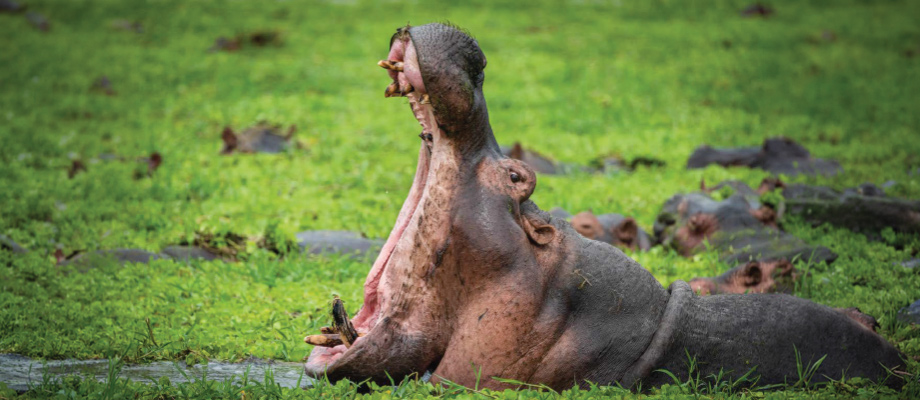
A hippo displaying its tusks in Katavi National Park
HOW CAN I MAKE THE MOST OF MY TRIP?
With a safari, when you go can be just as important as where you go. Peak season runs from June to October, in line with the country’s long, dry season. Game viewing is at its best during this time, but lodges, particularly along the Great Migration route, can get booked up well in advance and the parks are at their most crowded. Traveling during the short dry season, in January or February, offers a chance to witness the Great Migration without the rains, but with fewer safari vehicles on the ground competing for prime viewing.
Timing plays a role, too. Night game drives can transport guests into a rarely seen world as darkness transforms savannas and forests into primal hunting grounds under star-blanketed skies. Nighttime drives in the Serengeti aren’t permitted and are strictly limited to surrounding concessions and a handful of lodges with special arrangements. Tarangire, Ruaha and Nyerere national parks are more relaxed when it comes to after-dark adventure, adding to their wild appeal.
Sunrise is also one of the most action-packed times of day. During peak season, getting out early also means avoiding the crowds, particularly in the Ngorongoro Conservation Area.
Finally, don’t rush. The animal world dances to the beat of its own drum. Travelers with the luxury of time often manage to combine a successful safari adventure with a relaxing trip to the beaches of Zanzibar and its surrounding tropical islands.
Writer: Emma Al-Mousawi


